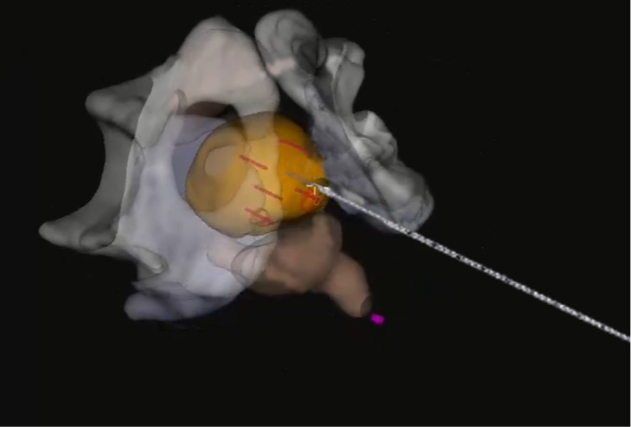
Four Functions.
One AI Layer.
Risk Stratification
AI driven intelligence categorizes and stratifies between suspicious and non-suspicious regions of interest.
Lesion Localization
AI localizes lesions on the input mpMRI — identifying targets before the procedure begins.
Procedure Planning
AI based planning by the physician in planning the biopsy approach, optimizing needle paths to target identified lesions.
Targeting Optimization
Optimized targeting support during the procedure, aligning the plan to the patient's live MR anatomy.
Where does AI fit in the procedure? Everywhere.
The AI layer sits between the mpMRI input and the live MR-guided procedure. It processes the externally acquired mpMRI, identifies targets, and produces a procedure plan that the physician reviews and adjusts before biopsy begins.
mpMRI data from the external scan is imported into the Promaxo system.
AI identifies and marks lesion locations on the imported mpMRI.
AI generates a targeting plan — needle paths, approach angles, sampling points.
The physician reviews, adjusts, and approves the plan before proceeding.
During the procedure, the plan is overlaid on live MR images for targeting.
Reducing variability.
Increasing consistency.
Improving patient outcomes.
Manual lesion targeting introduces variability — operator-dependent in ways that compound across busy practices. AI-assisted planning reduces that cognitive load by providing a reproducible, quantitative starting point for every procedure.
Reduced cognitive load
AI pre-identifies targets so the physician focuses on clinical judgment, not spatial reconstruction.
Consistent targeting
Every procedure starts from a quantitative plan, reducing operator-dependent variability.
Faster planning
Automated localization shortens the time between mpMRI import and procedure readiness.
Reusable across workflows
The AI layer is designed to support future workflows as new indications receive clearance.